Unraveling The Mysteries With Critical Inquiry
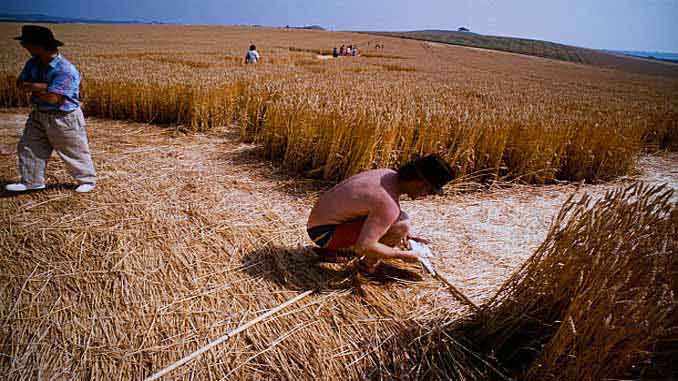
The enigmatic phenomenon of crop circles has long captured the public’s imagination and generated passionate discussions. While many are quick to embrace extraterrestrial or paranormal explanations, a significant degree of skepticism surrounds crop circles. In this article, we delve into the skepticism that questions the paranormal and proposes more down-to-earth explanations for these intricate designs etched into fields of crops.
Elaborate Hoaxes And Pranks
One of the most prevalent forms of skepticism surrounding crop circles centers on the idea that the majority of these formations are elaborate hoaxes and pranks carried out by individuals or groups. Over the years, there have been numerous instances where the creators of crop circles have come forward, admitting to using simple tools, such as boards and ropes, to craft their designs under the cover of darkness. This revelation has reinforced the belief that human artistry, rather than otherworldly forces, is responsible for most crop circles.
Inconsistent Witness Testimony
Another factor that contributes to skepticism is the inconsistency in witness testimony regarding the creation of crop circles. While some witnesses claim to have seen inexplicable lights or experienced unusual phenomena near the formations, others maintain that they saw no such occurrences. These inconsistencies raise questions about the reliability of eyewitness accounts and their correlation to the paranormal.
Lack Of Concrete Evidence
Skeptics argue that despite decades of crop circle observations, there is a notable absence of concrete, irrefutable evidence linking these formations to extraterrestrial activity or unexplained natural phenomena. They emphasize the need for empirical evidence, such as samples of crop circle materials with extraordinary properties, which could help substantiate the paranormal claims. The lack of such evidence, according to skeptics, weakens the case for otherworldly involvement.
Natural Explanations
Many skeptics point to well-documented natural explanations for crop circles as evidence against paranormal theories. These natural processes include meteorological phenomena like whirlwinds, wind patterns, and plant physiology. Skeptics argue that these factors can account for the intricate designs and geometric precision often observed in crop circles. They maintain that these natural explanations are more plausible and less convoluted than attributing the formations to extraterrestrial forces.
Artistic And Human-Made Motives
Skepticism extends to the notion that some crop circles are created purely for artistic expression or as elaborate pranks. The intricate and aesthetically pleasing designs seen in many formations can be viewed as the result of human creativity rather than otherworldly communication. The desire for attention and the challenge of crafting complex patterns can be powerful motivations for individuals or groups to create these formations.
Skepticism surrounding crop circles highlights the importance of critical inquiry and empirical evidence when exploring mysterious phenomena. While the allure of paranormal explanations remains strong for some, the skeptics remind us of the need for a rigorous examination of the evidence and the consideration of natural and human-made factors before embracing extraordinary theories. The debate continues, but it is the skeptical viewpoint that underscores the scientific method’s importance in understanding the unexplained.