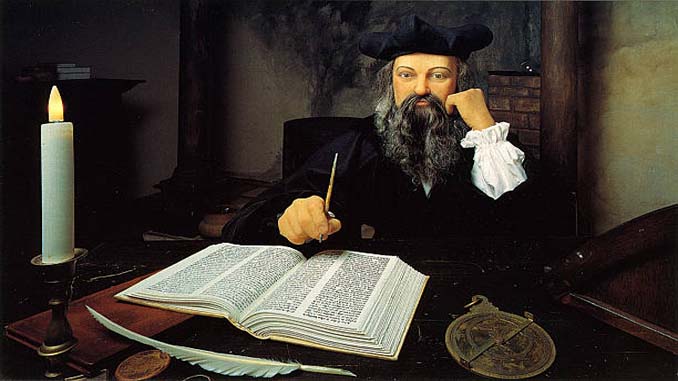
Michel de Nostredame, known as Nostradamus, was a 16th-century French astrologer and physician whose prophetic writings have captivated the imaginations of people for centuries. While he is renowned for his predictions of global events, political upheavals, and natural disasters, there’s an intriguing aspect of his work that suggests a connection to technology, despite the fact that he lived long before the digital age.
One of the most frequently cited quatrains associated with Nostradamus’ potential insights into technology is Quatrain 47 from Century 1, which reads:
“The speeches of Lake Leman will become angered,
The days will drag out into weeks, then months,
Then years, then all will fail.”
Interpreters have suggested that “Lake Leman” refers to Lake Geneva, a location that has played a significant role in the development of modern technology, particularly in the field of physics and computing. The reference to time dragging on, eventually leading to failure, is seen by some as a foreshadowing of the potential dangers of overreliance on technology and the concept of time dilation due to technological advances.
Quatrain 72 from Century 10 is also often cited in discussions about Nostradamus and technology:
“The year 1999, seventh month,
From the sky will come a great King of Terror:
To bring back to life the great King of the Mongols,
Before and after, Mars to reign by good luck.”
While the interpretation of this quatrain is highly speculative, some have connected it to the Y2K computer bug scare that gripped the world as the year 1999 approached. The notion of a “great King of Terror” descending from the sky is symbolically linked to fears of technology failing or wreaking havoc, which is precisely what many feared would happen with computer systems at the turn of the millennium.
It’s important to note that Nostradamus’ quatrains are highly metaphorical, and their vagueness has allowed for a wide range of interpretations. Critics argue that retrofitting his prophecies to fit technological advancements is a product of selective reading and confirmation bias, as Nostradamus could not have had direct knowledge of modern technology and its complexities.
While there are intriguing parallels between some of Nostradamus’ verses and contemporary technological concerns, it’s crucial to approach these connections with a healthy dose of skepticism. The scientific and technological revolutions of the modern age were beyond the comprehension of a 16th-century astrologer, and attributing knowledge of future technological developments to him is speculative at best.
The connection between Nostradamus’ writings and technology is fascinating but highly speculative. Nostradamus’ quatrains are open to numerous interpretations, and retroactively fitting them to contemporary technological issues can be subjective. His prophetic legacy is better appreciated for its literary value and historical significance than for its predictive accuracy regarding technology. The enduring enigma of Nostradamus continues to spark debates and discussions, but caution should be exercised when drawing connections to the realm of technology.